New project: “A birds-eye view to welfare: a quantitative framework and proof-of-concept evaluation in a cetacean“
Summary
This pilot project uses aerial photography from drones to analyse killer whale body condition, as an addition to our ongoing research on killer whale foraging behaviour and impact on harbour seal populations. We aim to integrate the body condition data with behaviour observations to inform about group-level motivational states and welfare (Box 1) in a quantitative framework (Box 2). As well as the citizen science drone footage contributed to ECOPredS, documenting successful feeding in inshore waters in Scotland, the project will also analyse data from known cases of feeding cessation in whales that were rescued from coastal entrapment in Norway (Norwegian Orca Survey).
What/why?
The Wild Animal Initiative funding is supporting a morphometric analysis of killer whale body shape in Scotland from the drone image contributions to ECOPredS. The analysis focuses on relative measures to indicate nutritional condition (such as the eye-patch ratio 1-3) that don’t require exact measurements of body length or drone altitude. Ideal images for this have the whales in the middle of the frame and at nadir position, directly below the camera at 90-degree angle. The whale-camera angles of course vary both due to filming and whale behaviour, and so a key part of the analysis will be to assess this variation and select a subset of images that can be used to measure body shape.
Once we have established robust measurements, we hope to compare body shape metrics to indicate fat stores e.g., between reproductive states (lactating vs pregnant females), behaviour states, and seasons, depending on sample size. The more robust measurements, the more confidently we can make such comparisons and say something about the nutritional status of the population. In collaboration with Eve Jourdain (Norwegian Orca Survey), we can also compare the measurements to killer whales in Norway 4. We are particularly interested in looking at footage from whales that were entrapped and subsequently rescued from inshore waters 5-6, as they can provide case studies for body condition during/after feeding cessation. Using standardised measurements such as the eye-patch ratio, we can consider how our measurements compare with published values for other populations.
When?
This is a one-year pilot project, May 2023 – April 2024, with image processing kicking the project off during the summer.
Who?
The project team includes Saana Isojunno, Eve Jourdain, Julia Sutherland, and Chloé Deleu. Chloé will process the images the extract the body shape metrics. Julia leads the handling of the drone metadata (such as time, pod id, etc) as part of her PhD. Saana leads the methodology development, statistical analysis, and manages the project. Eve co-leads the project with Saana and contributes drone footage from the study population in Norway. And of course, we couldn’t do this project without everyone contributing sightings, images and footage to the project!
How can I help?
You can help by reporting your sightings and sharing image/footage with us – from all around Scotland and different types of media. As well as drone footage from directly above the animals, we will consider whether side-on images (e.g., taken from land by a hand-held) can provide any clues on body condition.
Research ethics statement
The research methodology of this project has been vetted by the University of St Andrews Animal Welfare and Ethics Committee. The project team reviews contributed footage to ensure that any data contributing to our research adhere to responsible wildlife watching practice and guidelines. These guidelines, including our standard operating procedures for drone flights, can be found at our website: https://ecopreds.com/citizen-science/
More questions?
Please let us know if you have any questions or comments. As always, we also love to hear from potential new contributors and any interesting killer whale and predation observations. Please free to email us at ecopreds@st-andrews.ac.uk
Box 1: What does this have to do with welfare? The Wild Animal Initiative (https://www.wildanimalinitiative.org/) supports research into wild animal welfare. While animal welfare cannot be measured directly and can be challenging to define, most would agree that nutritional state is a key component of it. The term welfare is used in different ways and contexts to guide decision-making about animals. Often it is used to refer to subjective individual experience (like pain or pleasure) rather than individual health alone, or life history outcomes (like survival and reproduction). We consider welfare to comprise the multitude of positive and negative motivational states (e.g., satiation/hunger, safety/fear) that animals have evolved to be successful over evolutionary time scales. In practice, welfare should be predicted by individuals’ ability to meet their everyday needs (e.g., to eat, rest, socialize) and stay healthy and safe from illness and injury. Visual observations, photo-id, and drone footage of killer whales can provide data on these different aspects. Ultimately, we hope that with this project we can improve our understanding of welfare and welfare threats to killer whales in the North-east Atlantic.
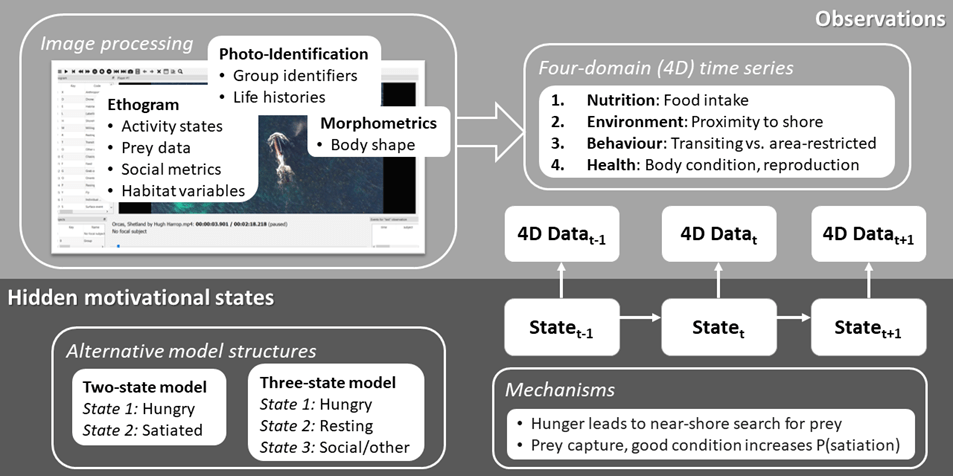
Box 2: Statistical framework We will pilot a statistical model that aims to make inferences about whales’ body condition and activity states as indicators of welfare from time series of drone data. The model will specify observations from the drone, such as body condition, group-level activity states (e.g., feeding attempts, transiting vs area-restricted movement) and environmental interactions (e.g., distance to shore) to emerge from a series of hidden states, representing the whales’ motivations (e.g., hunger, need to rest) switching from one state to another over time. This proof-of-concept combines a well-established statistical modelling approach (hidden Markov models)7 with the “Five domains” conceptual framework developed to understand animal welfare 8-9.
References
- Fearnbach, H., Durban, J.W., Ellifrit, D.K. and Balcomb, K.C., 2018. Using aerial photogrammetry to detect changes in body condition of endangered southern resident killer whales. Endangered Species Research, 35, pp.175-180. https://doi.org/10.3354/esr00883
- Stewart, J.D., Durban, J.W., Fearnbach, H., Barrett‐Lennard, L.G., Casler, P.K., Ward, E.J. and Dapp, D.R., 2021. Survival of the fattest: linking body condition to prey availability and survivorship of killer whales. Ecosphere, 12(8), p.e03660. https://doi.org/10.1002/ecs2.3660
- Kotik, C., Durban, J.W., Fearnbach, H. and Barrett‐Lennard, L.G., 2022. Morphometrics of mammal‐eating killer whales from drone photogrammetry, with comparison to sympatric fish‐eating killer whales in the eastern North Pacific. Marine Mammal Science. https://doi.org/10.1111/mms.12965
- Jourdain, E., Vongraven, D., Bisther, A. and Karoliussen, R., 2017. First longitudinal study of seal-feeding killer whales (Orcinus orca) in Norwegian coastal waters. PLoS One, 12(6), p.e0180099. https://doi.org/10.1371/journal.pone.0180099
- Jourdain, E., Karoliussen, R., Cure, C., Massenet, M., Barrett-Lennard, L. and Ellis, G.M., 2019. A case of natural killer whale (Orcinus orca) entrapment in northern Norway: from assessment to rescue. Aquatic Mammals, 45(1), pp.14-20. https://doi.org/10.1578/AM.45.1.2019.14
- Jourdain, E., Barrett-Lennard, L.G., Ellis, G.M., Ford, J.K., Karoliussen, R., Towers, J.R. and Vongraven, D., 2021. Natural Entrapments of Killer Whales (Orcinus orca): A Review of Cases and Assessment of Intervention Techniques. Frontiers in Conservation Science, p.45. https://doi.org/10.3389/fcosc.2021.707616
- Zucchini, W., Raubenheimer, D. and MacDonald, I.L., 2008. Modeling time series of animal behavior by means of a latent‐state model with feedback. Biometrics, 64(3), pp.807-815.
- Mellor, D.J. and Reid, C.S.W., 1994. Concepts of animal well-being and predicting the impact of procedures on experimental animals. https://www.wellbeingintlstudiesrepository.org/exprawel/7/
- Nicol, C., Bejder, L., Green, L., Johnson, C., Keeling, L., Noren, D., Van der Hoop, J. and Simmonds, M., 2020. Anthropogenic threats to wild cetacean welfare and a tool to inform policy in this area. Frontiers in veterinary science, 7, p.57. https://doi.org/10.3389/fvets.2020.00057
 ECOPredS project